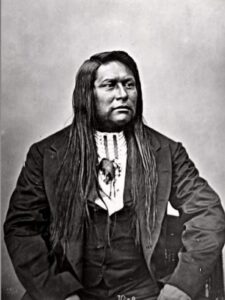
Tabby-To-Kwanah was born in 1789, in Ouray Indian Reservation, Uintah, Utah. His life must’ve been one of constant change. As late as 1814 there are tales of the Spanish mining for gold in the Uintah Mountains. History suggests an Indian rebellion took place and the Spanish were slaughtered. However; peace didn’t last long. The Mormon pioneers arrived in 1847. Although, Towatts, their God, had told them about the arrival of the “Tall Hats”, they had no idea they would be displaced from their lands. It was during this time Tabby became a chief and seen so much heartbreak and the loss of his people; nonetheless, his desire was to remain peaceful. He agreed to sign the Spanish Fork treaty and go to the Uintah Reservation in 1865. An Indian Agency was formed in Tabiona to help the natives establish. However, this attempt failed and in the winter of 1867, Chief Tabby asked Indian Agent Pardon Dodds, to relocate them to Whiterocks, Utah where the weather was more mild.
Chief Tabby was married to Un- Ca- Towie. She was born in 1835. (Her death is unknown). Their (documented) children are:
Appawoo or Unca-shoots, male 1847-1918
Martha Lincoln or Tavian, female 1848-Sept. 16, 1964
Atcheocup Taveapont, male, 1850-1931
Tecumseh or Neuhman, male 1860-1948
Tabby Tom, male unknown-1867
Edgar, male 1868-1880
Quinn, male 1871-1924
Pan-Fin-Wy-field or Unca-shoots, male, 1882-1924.
He lived a long life and died in Whiterocks, in 1898, making him 109 years old. (Although he claimed to be much older.)
 Small Family
 Peaceful Rest
 Storytelling